
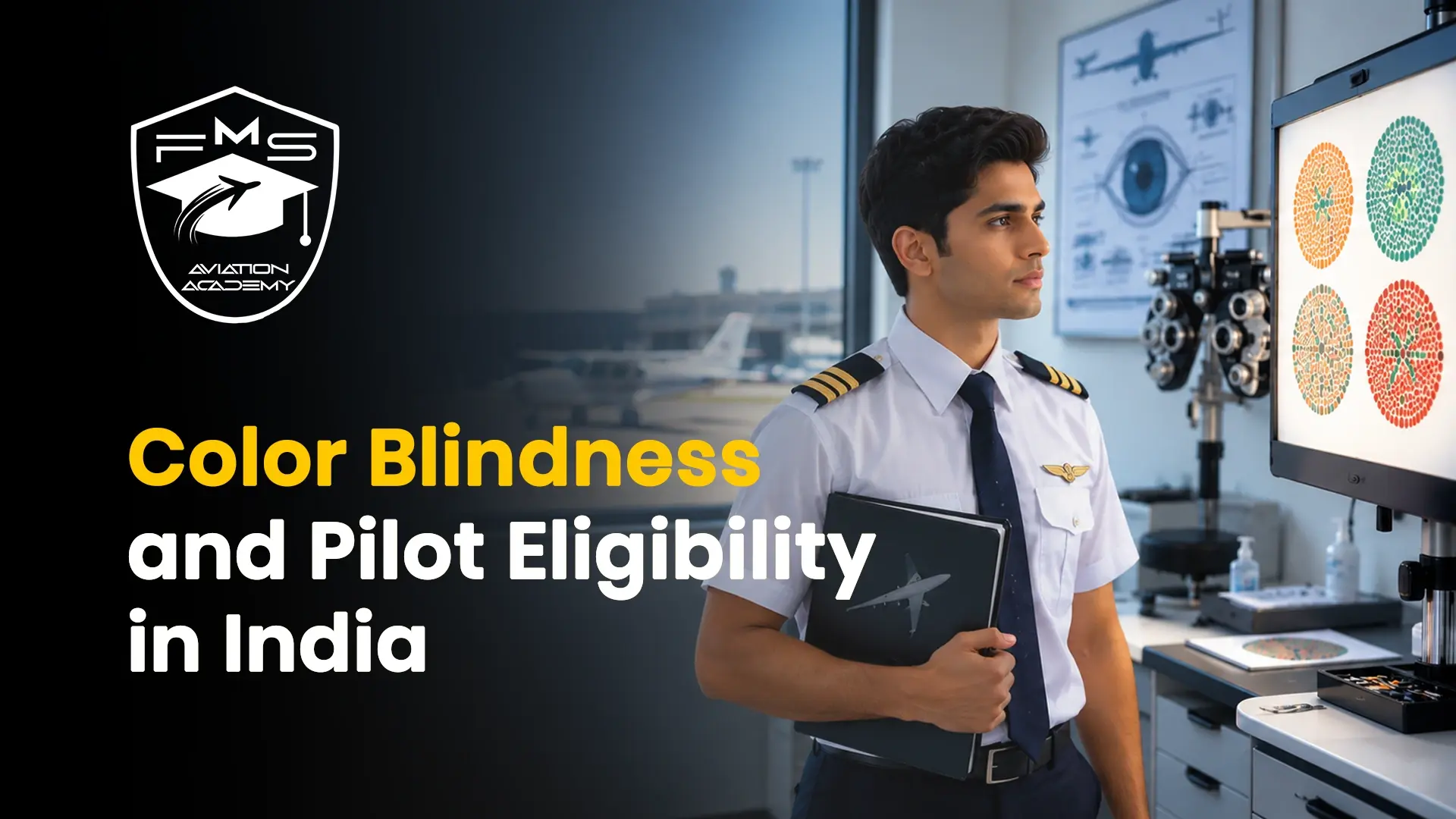
Color Blindness and Pilot Eligibility in India
Home Color Blindness and Pilot Eligibility in India If you are worried that color blindness might end your pilot dream...
FREE Guidance · The Full Journey
9 steps. Zero confusion. Everything you need to go from student to cockpit — in simple terms.
Scroll to explore all steps
The entry bar is more accessible than most people think. Students from any stream — Science, Commerce, or Arts — can pursue pilot training. Here's what DGCA actually requires.
Science is not mandatory. Students from Commerce or Arts backgrounds are equally eligible to pursue pilot training.
Any streamPhysics and Mathematics at the 10+2 level are required. If you didn't study them in school, you can complete them through NIOS or an equivalent recognised board.
NIOS acceptedThere is no minimum marks requirement to begin pilot training. Note that some airline cadet programmes may set their own academic criteria.
No cut-off to startYou can apply for a Student Pilot Licence at 17. You must be at least 18 to apply for a Commercial Pilot Licence.
Age criteria| Requirement | Minimum | Notes |
|---|---|---|
| Education | Class 12 (any stream) | Equivalent board accepted |
| Subjects | Physics & Maths | NIOS allowed if not done in school |
| Percentage | No minimum | Some cadet programmes may require 60%+ |
| Age (SPL) | 17 years | Student Pilot Licence |
| Age (CPL) | 18 years | Commercial Pilot Licence |
| Nationality | Indian citizen | OCI/PIO may apply under specific conditions |
Many pilots began without a science background. NIOS lets you complete Physics and Maths as an adult learner — it typically takes 6–12 months and is DGCA-recognised.
Can I start training while still in Class 12?
No — you need to have completed Class 12 before applying for an SPL. However, you can research flight schools, appear for medicals, and prepare your documents while you finish school.
Does it matter which board I'm from — CBSE, ICSE, state board?
No. DGCA recognises all recognised Indian boards. What matters is that you have passed Class 12 with Physics and Mathematics, regardless of which board conducted your exam.
What if I failed Maths in school?
You can appear for the subject as an improvement or complete it through NIOS. Once you have a passing certificate showing Physics and Maths at the 10+2 level, you're eligible.
Talk to our advisors — we'll assess your documents and tell you exactly what steps to take next.
The DGCA eGCA portal is your official aviation identity for life. Every licence, medical, exam result, and flight log is tied to this account. Getting it set up correctly from day one saves a lot of headaches later.
The eGCA portal is where DGCA tracks your entire aviation career — from your first SPL application to your CPL and beyond.
Mandatory first stepYou'll upload your Class 12 marksheet, ID proof (Aadhaar/passport), photographs, and any other documents required for licence applications.
Scanned copies acceptedYour flying training organisation submits your logbook hours to DGCA via eGCA. Your medical, exam passes, and licence endorsements all live here.
Auto-updated by FTOFrom SPL to CPL to ATPL, all DGCA interactions happen through eGCA. Airline employers also verify licences through this portal.
Lifetime accountGo to egca.dgca.gov.in — this is the official portal. Do not use any third-party site or agent to register; the process is free and straightforward.
Register with your name (exactly as on your Aadhaar or passport), date of birth, and a valid email and mobile number. These details are permanent and must match your official documents.
Required documents include: a valid photo ID (Aadhaar or passport), Class 12 marksheet, and a passport-size photograph against a white background.
Once your profile is active, you can apply for a Student Pilot Licence through eGCA. You'll also need a DGCA Computer Number to register for the CPL theory exams.
Make sure your name on eGCA matches your Aadhaar and Class 12 certificate exactly — including spelling and initials. Mismatches can delay licence applications by weeks.
Is there a fee to register on eGCA?
No — creating an account on eGCA is free. Individual licence applications and endorsements have DGCA fees, but account registration costs nothing.
Can I register before I've completed Class 12?
You can create an account, but you won't be able to submit applications that require Class 12 documents. We recommend registering once you have your marksheet in hand.
Our team can walk you through the registration and ensure your documents are correctly uploaded.
Medical certification is one of the first practical steps in pilot training — and one that applicants are most anxious about. The requirements are real but the vast majority of students who want to fly are medically fit to do so.
Required before you can begin flying training. Less strict than Class 1, but still covers vision, hearing, cardiovascular, and general health.
Before training startsRequired before your CPL is issued. Stricter standards — especially for vision and cardiovascular health. Conducted only by DGCA-approved examiners.
Before CPL issuanceYour medical must be done by a DGCA-approved Aviation Medical Examiner (AME). Results from non-approved doctors are not accepted.
Approved list on DGCA siteIncludes visual acuity, colour vision, audiometry, ECG, blood tests, and a general physical examination. Corrected vision (glasses/contacts) is acceptable for Class 2.
Glasses allowed (Class 2)| Parameter | Class 2 | Class 1 |
|---|---|---|
| When required | Before flying training (SPL) | Before CPL issuance |
| Vision (unaided) | 6/60 each eye minimum | 6/9 each eye (correctable to 6/6) |
| Colour vision | Normal colour perception | Normal colour perception |
| Validity | 5 years (under 40), 2 years (40+) | 12 months (under 40), 6 months (40+) |
| Glasses/contacts | Allowed | Allowed (within limits) |
Don't wait until you're about to start training. Do your Class 2 medical as soon as you've decided to pursue a pilot licence. If there's any issue, you'll have time to address it before committing financially.
I wear glasses — can I still become a pilot?
Yes, in most cases. DGCA allows corrected vision (glasses or contact lenses) within specified limits. What matters is your corrected visual acuity, not whether you need correction.
Where can I find a DGCA-approved AME?
The DGCA website publishes an updated list of approved Aviation Medical Examiners. Major cities including Delhi, Mumbai, Chennai, Hyderabad, and Bengaluru have multiple approved examiners.
What happens if I fail the Class 1 medical?
You can request a review or seek assessment by the Central Medical Establishment (CME) of DGCA. Some conditions that initially result in a fail can be reconsidered with specialist reports and documentation.
We can point you to DGCA-approved AMEs and advise you on what to expect before your assessment.
Ground school covers the theoretical knowledge required to pass the DGCA CPL written exams. It's demanding — six subjects, each requiring 70% to pass — but with the right preparation it's very manageable.
Charts, instruments, GPS, dead reckoning, and flight planning calculations.
Weather systems, METAR/TAF reading, icing, thunderstorms, and fronts.
DGCA rules, ICAO standards, airspace classification, and licensing law.
Aircraft systems, engines, hydraulics, electrics, pressurisation, and instruments.
Systems specific to the aircraft category you're training on (piston/turboprop).
Radiotelephony licence — phraseology, procedures, and a separate oral exam.
Apply for your Computer Number through the eGCA portal. This is separate from your pilot licence number and is specifically for registering for theory exams on the Pariksha portal.
Study at your own pace with recorded lectures, live doubt-clearing sessions, and downloadable notes — designed around your schedule.
Flexible formatYou don't have to pay for all six subjects upfront. Start with the subjects you want to clear first and add more as you go.
Pay as you learnAccess thousands of DGCA-pattern questions with explanations. Free practice tests available on our portal — no login required.
Free accessHow long does ground school take?
Most students complete all six subjects in 6–12 months, depending on how many subjects they take simultaneously and how many hours they study per week.
Can I study ground school before starting flying training?
Absolutely — and we recommend it. Clearing your theory exams before or during flying training means you're not juggling two demanding workloads at the same time.
What's the passing mark?
70% in each subject. Results are valid for 5 years from the date of your first pass. You must clear all six within that window.
Access our DGCA theory prep — subject by subject, at your pace.
The DGCA theory exams are computer-based and conducted through the Pariksha portal. There are six subjects to clear, each independently. Understanding the format removes a lot of the anxiety.
All six DGCA CPL theory exams are conducted online through the government's Pariksha portal. You register via your DGCA Computer Number.
Online portalRegular exams are held every 3 months. On-Demand sessions are also available at authorised test centres — giving you more flexibility in scheduling.
On-demand availableMinimum passing mark is 70% in each subject. There is no penalty for wrong answers. Results remain valid for 5 years from your first pass.
70% pass markAccess DGCA-pattern questions on our portal with full explanations — no login needed. Regular practice is the single most effective preparation strategy.
Free on this portal| Subject | Questions | Duration | Pass mark |
|---|---|---|---|
| Air Navigation | 40 | 60 min | 70% |
| Meteorology | 40 | 60 min | 70% |
| Air Regulations | 40 | 60 min | 70% |
| Technical General | 40 | 60 min | 70% |
| Technical Specific | 40 | 60 min | 70% |
| RTR (A) | Oral + written | Varies | 70% |
Your first exam pass starts the clock. All six subjects must be cleared within 5 years of that first pass date. Plan your exam order carefully — start with subjects you're most confident in.
How many attempts do I get?
There is no limit on the number of attempts per subject. You can re-appear in the next available session if you don't pass. Most students clear each subject in 1–2 attempts with proper preparation.
Can I appear for multiple subjects in the same session?
Yes — you can register for multiple subjects in the same exam session, as long as the timings don't clash. Many students clear 2–3 subjects in a single visit.
Where are the exam centres?
DGCA Pariksha exam centres are available across major cities. The exact list of centres for each session is published on the Pariksha portal when you register.
Access our DGCA question bank with thousands of CPL-pattern questions and full explanations.
There are two main routes to becoming a commercial pilot in India. Understanding the differences helps you decide which path fits your situation — and prepares you to compete for the route you choose.
Airlines like IndiGo, Air India Express, and SpiceJet run structured cadet programmes. They fund or part-fund your training in exchange for a service bond. Competitive selection — aptitude tests, simulator assessment, interviews.
You fund your training independently through an FTO of your choice, in India or abroad. Maximum flexibility — you choose your school, timeline, and aircraft type. Apply to airlines once your CPL and hours are complete.
Submit your application with academic records, ID, and any required essays or forms. Airlines shortlist based on eligibility criteria before inviting candidates to testing.
Computer-based tests covering numerical reasoning, spatial orientation, memory, and multi-tasking. These assess pilot-specific cognitive abilities.
Basic aircraft handling in a simulator. Assessors look at how you receive and apply instructions, your coordination, and how you manage workload — not previous flying experience.
Technical questions on physics, aviation basics, and situational judgement. HR assesses communication, decision-making, and professional composure.
Cadet aptitude tests are unlike standard exams — they assess cognitive speed and accuracy under time pressure. Regular timed practice with aviation-specific test formats is the most effective preparation.
Do I need flying experience to apply for a cadet programme?
No — cadet programmes are designed for ab-initio (zero-experience) candidates. Airlines train you from scratch.
What's the bond period for cadet programmes?
Bond periods vary by airline — typically 3 to 7 years of service after type rating completion. If you leave early, you may be liable to repay a portion of your training costs.
Can I apply to multiple cadet programmes simultaneously?
Yes, and most candidates do. Selection timelines rarely clash, and having multiple processes running improves your chances of securing a spot in a cohort.
We run mock aptitude tests, simulator briefings, and interview prep for all major Indian carrier programmes.
Flying training is the core of your pilot journey. You'll need a minimum of 200 hours of flying time to apply for a CPL, broken down across solo, cross-country, instrument, and night flying requirements.
DGCA requires a minimum of 200 hours total flying time to apply for a CPL. This includes specific requirements for solo, cross-country, instrument, and night hours.
CPL requirementYou must train at a DGCA-approved Flying Training Organisation. Hours logged at non-approved schools are not counted towards your CPL application.
Approval mandatoryMany students train in the USA, Australia, or New Zealand where aircraft and fuel costs are lower. Hours from ICAO-member states are accepted by DGCA with proper validation.
Overseas acceptedThe duration depends on weather, aircraft availability, and how consistently you fly. Schools with good fleet availability and weather windows help you finish faster.
Weather-dependent| Category | Required hours | Notes |
|---|---|---|
| Total flying time | 200 hours | Minimum for CPL application |
| Pilot-in-Command (PIC) | 100 hours | Must include solo cross-country |
| Cross-country (PIC) | 20 hours | Including a 540km solo flight |
| Instrument flying | 20 hours | Min. 10 hours actual instrument time |
| Night flying | 10 hours | Including 5 hours solo night |
Your first solo flight. You'll build basic aircraft handling, circuits, emergency procedures, and solo cross-country flying. Duration: approximately 40–60 hours.
Cross-country flying, navigation, and basic instrument work. You'll reach the 50-hour mark and gain experience flying to different airfields.
Instrument rating training, night flying qualification, and building your remaining PIC hours. This phase completes your 200 hours and prepares you for the CPL skill test.
A DGCA-authorised examiner tests you on commercial flight manoeuvres, emergency procedures, and instrument flying. Pass this and your CPL is issued through eGCA.
India or abroad — which is better for flying training?
Both have tradeoffs. Overseas training (USA, Australia, NZ) is often faster and cheaper per hour due to lower fuel costs and better weather. India has the advantage of being closer to home. The key factor is fleet size and aircraft availability.
What does flying training cost?
In India, total costs typically range from ₹40–70 lakhs. In the USA or Australia, equivalent programmes often cost ₹35–55 lakhs when converted, but currency risk and living costs add up.
We've helped hundreds of students evaluate flying schools — let us help you compare options objectively.
A type rating qualifies you to fly a specific commercial aircraft type — most commonly the Airbus A320 or Boeing 737 in India. It's the final technical step before joining an airline as a First Officer.
Indian carriers predominantly operate the Airbus A320 family and Boeing 737. Your target airline will usually determine which type rating you pursue.
Airline determines typeSelf-funded ratings cost ₹12–25 lakhs. Through a cadet programme, the airline typically funds your type rating as part of the sponsorship arrangement.
Cadet route benefitAll type rating flying is done in a Level D full-flight simulator — the highest fidelity available. You'll log 40–50 simulator hours during your rating.
Simulator-basedType rating training must be conducted at a DGCA-approved Approved Training Organisation (ATO). Confirm the school is approved for your intended aircraft type.
ATO approval requiredSystems, limitations, and procedures for your specific aircraft — A320 or B737. Typically 3–4 weeks of intensive classroom and computer-based training.
All type rating flying is done in a Level D simulator. You log 40–50 simulator hours covering normal, abnormal, and emergency procedures.
A DGCA-authorised Type Rating Examiner assesses you in the simulator. Pass this and the type rating is added to your licence through eGCA.
After joining, you complete a structured set of supervised real-world flights before operating as a fully independent First Officer.
Airlines sometimes prefer to put you through their own ATO. Getting a self-funded type rating can occasionally work against you if the airline's ATO differs. Always confirm with your target airline before committing.
How long does a type rating take?
Typically 6–8 weeks from start to skill test, depending on simulator slot availability and the training programme pace.
Where can I do a self-funded A320 type rating in India?
Several DGCA-approved ATOs offer A320 type ratings — including facilities in Delhi, Mumbai, and Hyderabad. Abroad, Dubai, Singapore, and the UK are popular choices.
Timing it right makes a big difference. Talk to our advisors before you commit.
The final step is getting hired. Indian airlines run structured selection processes — and preparation makes a significant difference. Understanding what each stage involves helps you walk in with confidence.
Your CPL, medical, logbook, and academic records are verified before you're invited to the selection day. Keep all documents current and well-organised.
Documents checkedYou're put in a simulator to assess basic aircraft handling, crew coordination, and response to abnormals — not just stick-and-rudder skill.
Most candidates fail hereDeep questions on aircraft systems, meteorology, air law, and situational judgement. Your DGCA ground school knowledge gets stress-tested here.
Ground school revisitAirlines assess communication, decision-making under pressure, and cultural fit. Composure and clarity matter as much as knowledge.
Soft skills countYour CPL, medical, logbook, and academic records are verified. Documentation gaps get you screened out before reaching the selection day.
Computer-based assessments covering numerical ability, spatial reasoning, memory, and multi-task management. Usually 2–3 hours.
Handle normal circuits, basic instrument work, and one or two abnormal scenarios. Examiners watch how you manage, not just how you fly.
Typically back-to-back on the same day. Technical interview tests depth of knowledge; HR assesses communication and composure.
Successful candidates receive a conditional offer subject to background verification, final medical check, and bond signing (for sponsored routes).
Most rejections at the simulator round come from candidates who haven't touched a simulator since their CPL skill test. Regular simulator refreshers dramatically improve pass rates.
How many hours do I need to apply to Indian airlines?
Most carriers require a minimum of 200 hours total for fresh CPL holders, but competitive candidates often have 250+ hours with good quality experience in their logbook.
How long does the full selection process take?
From application to offer letter, the process typically spans 2–6 weeks. Background verification and joining can take another 4–8 weeks.
Can I apply to multiple airlines simultaneously?
Yes — and you should. Most pilots apply to 3–5 airlines in parallel. Selection timelines don't always align, so having multiple processes running improves your chances of a timely offer.
We run mock interviews, simulator briefings, and aptitude prep. Talk to us about what's right for your stage.
Home Color Blindness and Pilot Eligibility in India If you are worried that color blindness might end your pilot dream...
Home What Is Instrument Rating in Aviation? Instrument Rating is the qualification that allows a pilot to fly an aircraft...
Home What Is Type Rating in Aviation? A type rating is the certification that allows a pilot to fly a...
Home IGRUA Flying School: Courses, Fees and Training Guide IGRUA stands for Indira Gandhi Rashtriya Uran Akademi. It's a name...
Home How Much Do Pilots Earn in India Per Month? India's civil aviation sector is preparing for a major expansion....
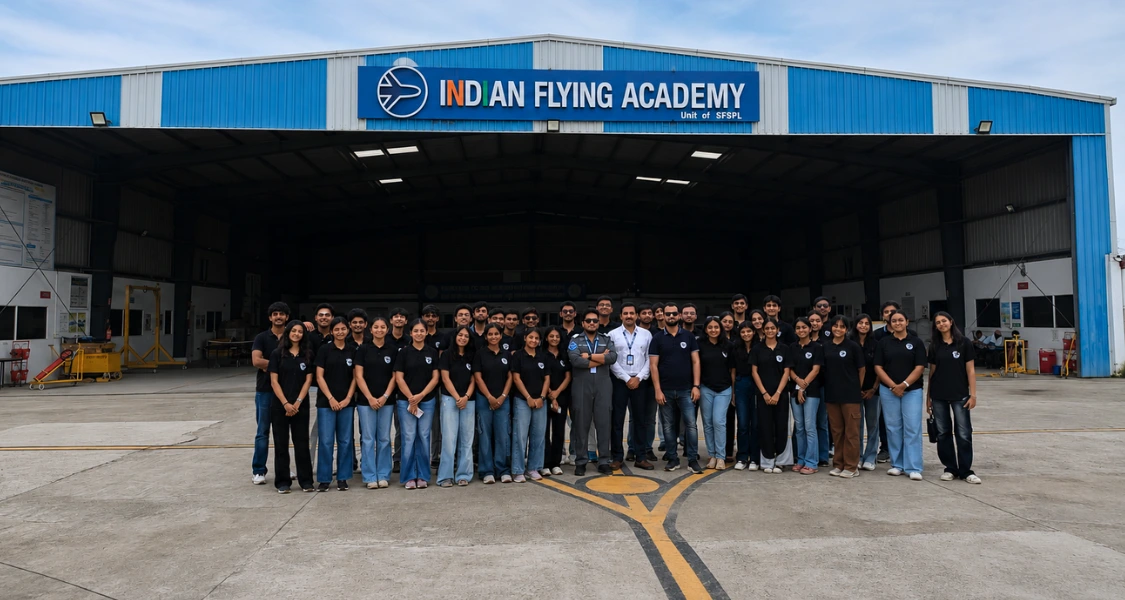
Home FMS Aviation Academy Organizes Free IFA Visit for Students FMS Aviation Academy organized a free IFA visit for its...