FMS Aviation Academy

What Is Instrument Rating in Aviation?

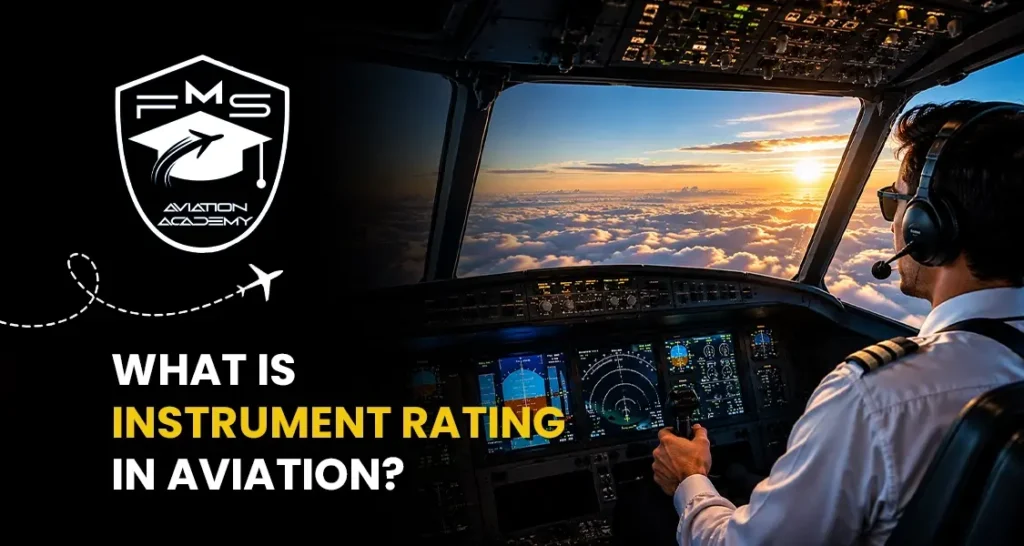
Instrument Rating is the qualification that allows a pilot to fly an aircraft using only the instruments in the cockpit, without relying on what they can see outside the window. Clouds, fog, heavy rain, night skies with no visible horizon, none of that stops a pilot who holds an Instrument Rating. They read altitude, speed, direction, and position entirely off the panel in front of them and fly the aircraft safely regardless of what’s happening outside.
Without it, a pilot is restricted to flying under what’s called Visual Flight Rules, meaning they need clear visibility and a visible horizon to fly safely. That’s fine for a short recreational flight on a sunny day. It’s nowhere near enough for commercial flying, where weather doesn’t always cooperate and airlines can’t cancel a flight every time there’s low cloud cover.

What Is Instrument Rating in Aviation

Why This Rating Exists in the First Place

Flying by sight alone works fine until the weather turns. Once a pilot loses visual reference to the horizon, whether from cloud, fog, haze, or darkness, the body’s own sense of balance becomes unreliable. Pilots can genuinely feel like they’re flying level when they’re actually banked into a turn. This is one of the more dangerous situations in aviation, and it’s exactly what instrument training is built to prevent.

An Instrument Rating trains a pilot to trust the instruments over their own physical sensations, read attitude indicators, altimeters, and navigation instruments correctly under pressure, and make decisions using data rather than gut feeling. It also covers the procedures for flying in controlled airspace under Instrument Flight Rules, which includes specific approach and departure procedures at busier airports.

How Instrument Rating Fits Into CPL Training in India

The training itself splits between ground knowledge and actual flying practice.

Ground instruction covers instrument flight rules, aviation weather in far more depth than basic ground school requires, radio navigation aids, approach procedures, and how controlled airspace actually works from a pilot’s side of the radio.

Flight training happens partly in the aircraft and partly in a simulator, often under a hood or view-limiting device that blocks the pilot’s outside view, forcing them to rely purely on instruments even in clear weather. DGCA does allow a portion of instrument flying hours to be completed on approved simulators, which helps cadets get repeated practice at approaches and emergency scenarios without burning aircraft hours on every attempt.

By the end of it, a cadet needs to demonstrate they can hold altitude, heading, and airspeed precisely while flying blind to the outside world, manage instrument approaches into an airport, and handle an unexpected system failure without ever looking up from the panel.

Simulator work plays a bigger role here than most new cadets expect going in. If you want a clearer picture of how that training environment actually works before you get there, flight simulator training breaks down what a full session actually looks like.

Have questions about where Instrument Rating fits into your own training plan? An FMS mentor can walk you through it. 📞 75994 01111 | Contact Us

Instrument Rating vs Type Rating: Not the Same Thing

These two get confused constantly, so it’s worth being direct about the difference. Instrument Rating qualifies you to fly by reference to instruments, a general skill that applies across any aircraft you’re licensed on. Type Rating qualifies you to fly one specific aircraft model, an Airbus A320 or a Boeing 737, and doesn’t transfer between aircraft types at all.

Think of the order this way. Instrument Rating comes first, built into your CPL. Type Rating comes later, after your CPL is complete, when you’re preparing to join an airline and need certification on the exact aircraft you’ll be flying. You genuinely can’t skip to a type rating without already holding an Instrument Rating, since type rating training assumes you can already fly on instruments and builds aircraft-specific procedures on top of that foundation. Type rating training works differently enough from Instrument Rating that it deserves its own explanation entirely.

Why This Rating Matters for Your Airline Career

No airline in India hires a First Officer who can only fly visually. Every commercial flight operates under instrument flight rules for at least part of the journey, departures, arrivals into busy airspace, and any flight through weather all require it. Instrument Rating isn’t a nice-to-have qualification you can pick up later, it’s the baseline that makes you employable as an airline pilot at all.

It also directly affects how confident you’ll feel once you’re actually flying for a living. A pilot who trained properly on instruments doesn’t panic the first time they hit real cloud cover on a scheduled flight. That composure under pressure is exactly what airlines are screening for during interviews and line training, and it starts with how seriously this phase of training gets taken.

Not sure how Instrument Rating fits into your training budget or timeline? Talk to an FMS expert and get a clear answer. 📞 75994 01111 | Contact Us | Browse All Courses

FAQs: Instrument Rating in Aviation

What is Instrument Rating in simple terms?

Instrument Rating is a pilot qualification that allows flying an aircraft safely using only cockpit instruments, without needing to see outside the aircraft. It’s required for flying in clouds, fog, poor visibility, or at night in controlled airspace.

Is Instrument Rating separate from CPL in India?

Not in practice. DGCA builds Instrument Rating training directly into the standard 200-hour CPL syllabus, so Indian CPL holders complete it as part of their core training rather than adding it on afterward.

Is Instrument Rating the same as Type Rating?

No. Instrument Rating is a general skill for flying by instruments that applies across aircraft types. Type Rating is aircraft-specific certification, such as for the A320 or 737, and is completed separately after CPL, once you already hold Instrument Rating.

Can simulator hours count toward Instrument Rating?

Yes, DGCA permits a portion of instrument flying hours to be completed on approved flight simulators, which allows repeated practice on approaches and emergency procedures without using additional aircraft hours.

Why do airlines require Instrument Rating?

Every commercial flight in India involves instrument flight rules at some stage, departures, arrivals, and flying through weather all require it. Airlines cannot operate scheduled flights with pilots who can only fly under visual conditions.

Related Posts

DGCA CPL Training in India
Pilot Training

DGCA CPL Training in India

Home DGCA CPL Training in India: Complete 2026 Guide for Pilot Aspirants DGCA CPL training in India qualifies you to fly commercially as a licensed

Read More »