FMS Aviation Academy

Compare Cadet Pilot Program Vs Conventional Training

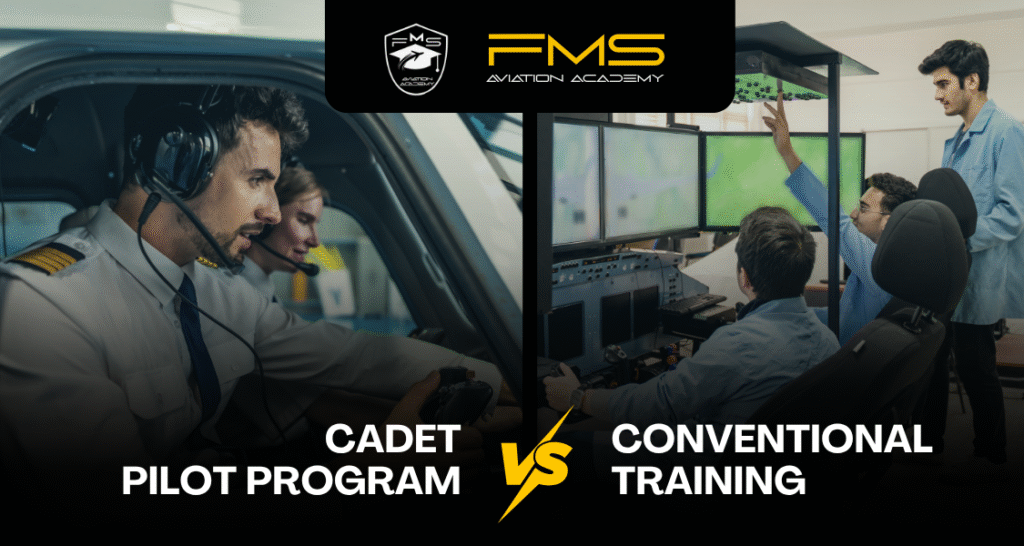
Choosing the right pathway matters when you’re aiming for the cabin of a commercial aircraft. The key comparison is Cadet Pilot Program vs Conventional Training for aspiring pilots in India. 

Whether you’re targeting your first airplane pilot licence or planning a full-scale career with high pilot salary and pilot income, this blog helps you evaluate these two routes. 

FMS Aviation Academy can support your pilot licence journey efficiently.

What is Cadet Pilot Program?

A Cadet Pilot Program is a structured airline-sponsored pathway that takes you from zero experience to the First Officer’s seat. It combines ground training, flight training, and airline-specific procedures under one integrated plan. Major airlines like IndiGo, Air India, and SpiceJet offer such programs in India.

Unlike conventional routes, these programs come with a Letter of Intent (LOI) — ensuring a clear career path post-training. However, they are highly competitive and involve significant investment.

 To understand eligibility, selection stages, and costs in detail, read our complete guide on Cadet Pilot Programs in India.

Join our Airline Entrance Exam Preparatory Course to secure your seat in top Cadet Pilot Programs!

What is Conventional Training?

Conventional Pilot Training follows the traditional route where students independently enroll in DGCA-approved flying schools to earn licences like PPL, CPL, and ATPL. You choose your own flight school, plan your training pace, and later apply to airlines based on merit and experience.

This route offers flexibility and affordability, though it lacks the job assurance that cadet programs provide. Success depends on consistent performance and smart flight-hour building.

For a head start on your journey, explore DGCA Ground Classes and CPL Courses by FMS Aviation Academy to strengthen your foundation.

Cadet Pilot Program vs Conventional Training: Training, Cost & Job Pathways

Training Structure & Certification

  • Cadet Pilot Programs offer complete, airline-integrated training. You learn ground subjects, complete flight hours, and earn your Commercial Pilot Licence under one structured path. Most programs also provide airline-specific simulator and procedure training.

  • Conventional Training lets you join any DGCA-approved flying school, finish CPL training, and later apply to airlines independently. It offers flexibility but no guaranteed placement.

Cost & Investment

  • Cadet programs cost around ₹1 crore or more. The higher price includes advanced simulators, assessments, and airline readiness.

  • Conventional pilot training usually costs less overall, but you must fund separate type ratings and job search costs later.

Job Assurance & Career Launch

  • Cadet programs offer a direct route to airlines with higher job security after training. Many provide a Letter of Intent for employment.

  • Conventional training gives more freedom, but finding an airline job depends on your own performance, network, and flight experience.

Flexibility & Risk

  • Conventional training offers control over location, school, and pace. It suits students seeking independence and lower initial costs.

  • Cadet programs come with bonds and fixed airline terms. While structured, they carry higher financial risk if plans change.

Which Path Suits You?

If your goal is to join an airline quickly with assured support, then a cadet pilot program may be “better” for your goals. If you prefer flexibility, lower initial financial stress, or want broader job options (charter, instructor, cargo) then the conventional training route makes sense.

Here are questions you should ask:

  • How much can I invest upfront?

  • Do I need guaranteed employment immediately?

  • Am I comfortable being tied into job terms of the cadet programme?

  • Do I prefer to explore various pilot jobs rather than commit early to one airline?

  • What is my timeline to start earning and recoup investment?

Need clarity on how to begin your aviation journey? Take the first step with a detailed guide on how to become a pilot in India.

Kickstart Your Pilot Training

Ready to take the first step toward your aviation career?

Enrol for DGCA-approved courses at FMS Aviation Academy. Get complete coverage of DGCA CPL Ground Training subjects:

  1. Air Navigation
  2. Aviation Meteorology
  3. Air Regulation
  4. Technical General
  5. Technical Specific
  6. RTR-Aero

To prepare for Entrance Exams for Cadet Pilot Programmes, join our Airline Exam Prep Course. It includes classes for

  1. Written Test Preparation
  2. Psychometric & Aptitude Test Prep
  3. Simulator Training
  4. Interview and Soft Skills Training

FMS ensures you meet pilot eligibility, complete pilot training, and gain certifications efficiently. 

Contact FMS Aviation Academy today and book a counselling session to map your path to the cockpit.

Why Choose FMS Aviation Academy?

Finding genuine pilot training in India isn’t easy — here’s why FMS Aviation Academy truly stands out:

  • Proven Results: 300+ students trained successfully across India.

  • AI-Powered Learning: India’s first smart platform for DGCA ground classes.

  • Expert Mentorship: Learn directly from a Senior Airline Captain.

  • Concept-Based Training: Build real understanding, not rote knowledge.

  • Transparent Guidance: No fake approvals or inflated success claims.

  • Career-Oriented Coaching: From DGCA prep to airline readiness.

  • Lifetime Mentorship: Continuous support through flight training and interviews.

Conclusion

In short: the right path depends on your budget, risk appetite and career goal. A cadet programme offers structure and job placement; conventional training offers more flexibility and possibly lower upfront cost. Whichever you choose, make sure you’re clear on titles, training duration, costs and job outlook. The cockpit awaits—choose wisely and fly high!

FAQs on Best Pilot Training Institute in Delhi

Related Posts

DGCA Ground Classes in Delhi for CPL Theory Papers
Pilot Training

DGCA Ground Classes in Delhi for CPL Theory Papers

Home DGCA Ground Classes in Delhi for CPL Theory Papers Commercial Pilot Licence (CPL) training involves more than just flying skills. Aspirants for the theoretical exams must have knowledge of aviation regulations, navigation, meteorology and aircraft systems. The DGCA Ground classes in Delhi help the candidates to organise their studies,
Read More »
Commercial Pilot Salary in India by Experience Level
Pilot Training

Commercial Pilot Salary in India by Experience Level

Home Commercial Pilot Salary in India by Experience Level A career in commercial aviation offers the potential for attractive earnings, but the commercial pilot salary varies throughout a pilot’s career. Experience, airline rank, aircraft type, flying hours and employment terms all influence a pilot’s income. Aspiring pilots and their parents

Read More »
IGRUA Pilot Training Fees Breakdown for Students
Pilot Training

IGRUA Pilot Training Fees Breakdown for Students

Home IGRUA Pilot Training Fees Breakdown for Students Planning to become a commercial pilot in India  involves more than choosing a flight training institute. Students also need to understand the total cost of training, additional expenses and admission requirements before making a decision. The IGRUA pilot training fees are an

Read More »
Minimum Salary of Pilot in India at Entry Level
Pilot Training

Minimum Salary of Pilot in India at Entry Level

Home Minimum Salary of Pilot in India at Entry Level A pilot’s starting salary in India depends on the airline, job position, experience, and employment contract. For aspiring pilots and their families, entry-level earnings are an important consideration when evaluating the financial investment involved in aviation training. A newly qualified

Read More »
DGCA Approved Flying Schools in India
Pilot Training

DGCA Approved Flying Schools in India: A Student Checklist

Home DGCA Approved Flying Schools in India: A Student Checklist Choosing a flying school is an important step towards becoming a commercial pilot. The quality of training, access to aircraft, instructor availability and overall learning environment can influence how smoothly a student progresses through pilot training. However, choosing a school

Read More »
DGCA CPL Requirements Every Aspirant Should Check
Pilot Training

DGCA CPL Requirements in India for Aspiring Pilots

Home DGCA CPL Requirements Every Aspirant Should Check In India, becoming a commercial pilot requires more than a passion for flying. Aspiring pilots must meet specific educational, age, medical, examination and flight-training requirements established by the Directorate General of Civil Aviation (DGCA). Understanding the DGCA CPL requirements before beginning your

Read More »
Air Regulations DGCA Notes
Pilot Training

Air Regulations DGCA Notes and Study Guide for CPL

Home Air Regulations DGCA Notes: A Complete Study Guide for CPL Exam Preparation Preparing for the Commercial Pilot Licence (CPL) examination requires more than memorising aviation terminology. Students must have a clear understanding of the rules that govern aircraft operations, pilot, licensing, airspace and aviation safety. This is where well

Read More »
Color Blindness and Pilot Eligibility in India
Pilot Training

Color Blindness and Pilot Eligibility in India

Home Color Blindness and Pilot Eligibility in India If you are worried that color blindness might end your pilot dream before it starts, here’s the direct answer. Under current DGCA standards, red-green color blindness is treated as a permanent disqualifying condition for a Commercial Pilot License, with no waiver process.

Read More »
What Is Instrument Rating in Aviation
Pilot Training

What Is Instrument Rating in Aviation?

Home What Is Instrument Rating in Aviation? Instrument Rating is the qualification that allows a pilot to fly an aircraft using only the instruments in the cockpit, without relying on what they can see outside the window. Clouds, fog, heavy rain, night skies with no visible horizon, none of that

Read More »