How Much Do Pilots Earn in India Per Month?
Home How Much Do Pilots Earn in India Per Month? Pilots in India earn between ₹30,000 and ₹15 lakh per month. Pay depends on rank,
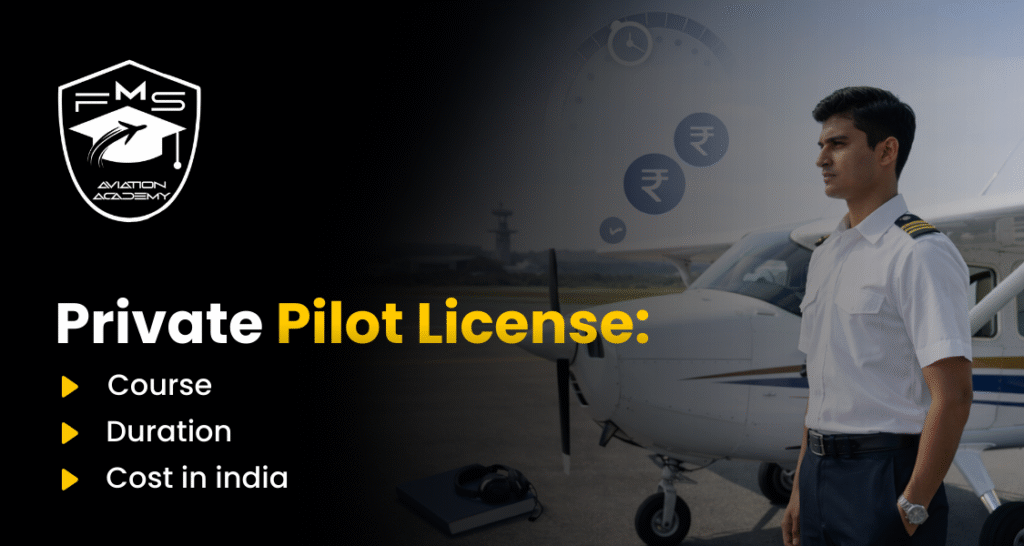
A Private Pilot License in India is the first formal step into aviation flying.
It allows pilots to fly aircraft for personal and non-commercial purposes.
Many aspiring airline pilots begin with a PPL to build strong flying fundamentals.
Understanding the PPL course, duration, and cost in India is essential before enrolling.
FMS Aviation Academy bring out a guide with everything you need to know before you begin your journey.
A Private Pilot License permits recreational and personal flying only.
PPL holders cannot earn money by flying aircraft.
The license is regulated by the Directorate General of Civil Aviation (DGCA) in India.
PPL training focuses on basic aircraft handling, navigation, and safety procedures.
To apply for a PPL in India, candidates must meet DGCA eligibility norms.
Candidates must have passed 10+2 from a recognized board.
Physics and Mathematics are recommended but not mandatory for PPL.
You can take bridge courses for the two subjects from NIOS.
The minimum age for a Private Pilot License is 17 years.
A DGCA Class 2 medical certificate is mandatory before solo flying.
The PPL course in India includes ground school and flight training modules.
Ground classes cover Air Navigation, Meteorology, and Air Regulations.
Strong theory preparation improves flying safety and exam performance.
You can explore DGCA Ground Classes at FMS for structured preparation.
DGCA mandates a minimum of 40 flying hours for PPL issuance.
This includes dual flying, solo flying, and cross-country navigation.
The duration of PPL training in India ranges from 6 to 12 months.
Weather conditions and aircraft availability affect training timelines.
Consistent flying helps students complete the course faste
The cost of a Private Pilot License in India varies by flying school.
On average, PPL training costs between ₹8 to ₹15 lakhs in India.
Costs include aircraft rental, instructor fees, fuel, and exams.
Medical tests, equipment, and repeat flying hours add to total expenses.
PPL is ideal for aviation enthusiasts and early-stage pilot aspirants.
It builds strong stick-and-rudder skills and aviation discipline.
However, PPL alone does not qualify you for airline jobs.
Career-focused students should plan a CPL transition early.
A PPL allows non-commercial flying, while a CPL enables airline employment.
PPL requires fewer flying hours compared to a Commercial Pilot License.
Many students upgrade from PPL to CPL after gaining confidence.
Read our guide on Flight Training in India to understand the full pathway.
Explore courses offered by FMS Aviation Academy:
Pre-Type Rating Course: Upgrade your skills before your Type Rating.
Advanced Aircraft Systems & SOP Training
Multi-Crew Cooperation (MCC) & CRM
Glass Cockpit Orientation & Jet Handling
Simulator Practice & Assessment Prep
Post-Type Rating Course: Bridge the gap between training and airline readiness.
Aircraft Systems & Technical Refresher
SOPs & Airline Procedures
Real-World Scenario Training
Performance Under Pressure: Entrance Preparation
Wide-Body Aircraft Insights
Airline Entrance Preparation Course: Ace every stage of airline selection.
Written Test Preparation
Psychometric & Aptitude Test Prep
Simulator Training
Interview & Soft Skills Training
Airline Transport Pilot Licence (ATPL) Course: DGCA-mandated subjects covered.
Air Navigation
Radio Aids & Instruments
Meteorology
Bonus: Flying logbook preparation (DGCA format), eGCA application guidance & Viva eligibility support
4 Ground School Locations: Ahmedabad, Surat, Delhi & Upcoming in Dehradun
AI-Powered Learning Platform: India’s first smart DGCA preparation system
Expert Instruction: Learn directly from a Senior Airline Captain
One-on-One Counselling & Mentorship at every stage
Career-Focused Training: From DGCA exams to cadet programmes & airline selection
Trusted Track Record: 300+ students trained successfully across India
5+ Partner Flying Schools for seamless flight training pathways
10+ Years of Aviation Training Experience
Concept-Based Learning: Real understanding over rote memorization
Transparent Guidance: No misleading approvals or inflated claims
📞 Contact FMS Aviation Academy today.
The minimum age to obtain a PPL in India is 17 years.
DGCA requires a minimum of 40 flying hours for PPL.
Yes, PPL holders can upgrade to CPL with additional flying hours.
Physics is mandatory for PPL. You make take a bridge course from NIOS.
International flying requires license validation by foreign authorities.
Yes, PPL training costs significantly less than CPL training.
Join FMS Academy and ace your DGCA Exams.

Home How Much Do Pilots Earn in India Per Month? Pilots in India earn between ₹30,000 and ₹15 lakh per month. Pay depends on rank,

Home DGCA Ground School: CPL Ground School Guide & DGCA CPL Papers (2026) DGCA Ground School is mandatory theory training for every pilot aspirant in
Home DGCA CPL Training in India: Complete 2026 Guide for Pilot Aspirants DGCA CPL training in India qualifies you to fly commercially as a licensed

Home Aviation Courses in India: Top Aviation Programs & Career Pathways Aviation courses in India open many distinct career paths, not just pilot training. Aspirants

Home ATPL Eligibility in India 2026: Complete Guide for Aspiring Airline Captains Want to become an airline captain? ATPL eligibility in India requires you to

Home Best Cadet Pilot Program in India (2026) The best cadet pilot program in India offers guaranteed airline placement. India’s aviation sector faces a critical

Home What Is Multi-Crew Pilot Licence? The Multi-Crew Pilot Licence (MPL) is a specialized pilot certification for first officer roles in commercial aviation. Unlike traditional

Home Pilot Vacancy in India: 2026 Complete Guide Latest Pilot Vacancy in India 2026 India faces a critical pilot shortage with projections estimating 10,000 pilots

Home Career in Aviation After 12th Why Pursue a Career in Aviation After 12th? India’s aviation sector is expanding rapidly with new aircraft orders and