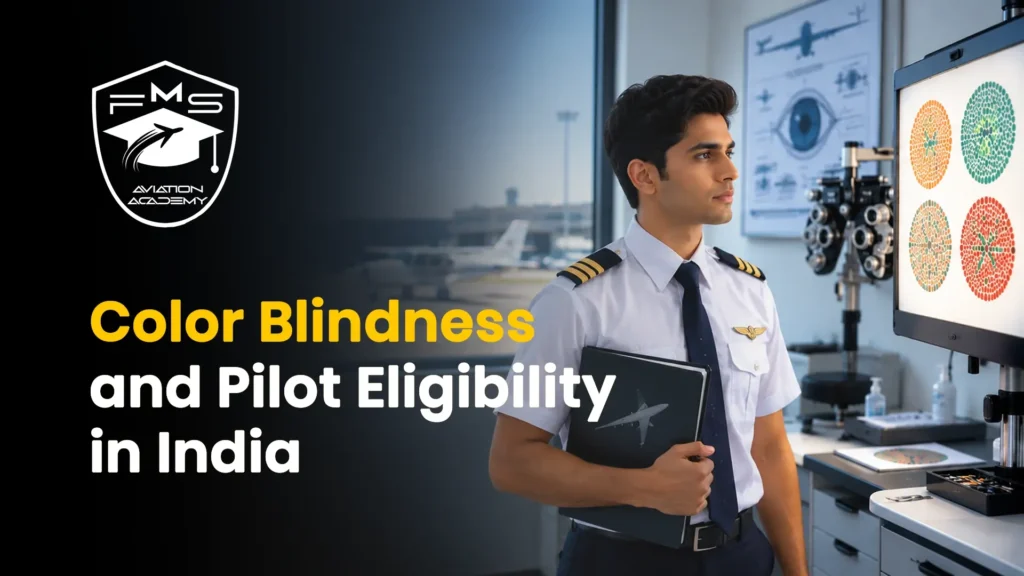
Color Blindness and Pilot Eligibility in India
Home Color Blindness and Pilot Eligibility in India If you are worried that color blindness might end your pilot dream before it starts, here’s the

If you are worried that color blindness might end your pilot dream before it starts, here’s the direct answer. Under current DGCA standards, red-green color blindness is treated as a permanent disqualifying condition for a Commercial Pilot License, with no waiver process. This isn’t the answer most students want to hear, but it’s better to know it clearly now than to find out after spending money on ground school.
That said, there’s more to this than a flat yes or no, and it’s worth understanding properly rather than panicking based on a rumor you heard from a senior or read in a random forum thread.

This isn’t an arbitrary rule DGCA picked for no reason. Aviation runs on color coded information in a way most other professions don’t. Runway lighting uses red, white, and green to communicate critical positioning information during landing. Cockpit warning systems use red for critical alerts and amber for cautions, a distinction that has to be instant and unmistakable, especially at night or in poor visibility. Navigation charts, instrument displays, and even air traffic control light gun signals when radios fail all depend on a pilot correctly identifying color under pressure, sometimes in a fraction of a second.
A pilot who can’t reliably tell red from green isn’t just at a disadvantage, they’re working with a genuine safety gap that color vision testing exists specifically to catch before it becomes a problem in the air.
Color vision gets checked at every stage of the medical process, not just once. Whether you’re applying for a Class 2 Medical for your Student Pilot License or a Class 1 Medical for your CPL, the Ishihara test is the standard first screening, a set of plates with colored dot patterns where numbers are hidden within different colors. Someone with normal color vision reads the number clearly. Someone with red-green deficiency often can’t see it at all, or sees a different number entirely.
This test takes a few minutes and is usually done during your very first medical checkup, well before you’d get anywhere near an aircraft.
Based on current DGCA medical standards, any degree of red-green color vision deficiency is treated as a permanent unfitness condition for CPL and ATPL, similar in severity to conditions like epilepsy or insulin-dependent diabetes. There’s no appeal process and no waiver once this is confirmed. This is consistent with how most Indian aviation medical guidance describes it, and it’s the standard our own counsellors work from when advising students.
You’ll sometimes come across mentions of secondary tests, a lantern test or a more advanced computer based color assessment, that in some countries can let candidates with very mild color deficiency still qualify after failing the initial screening. Whether something like that applies to your specific case in India isn’t something to guess at from a blog post, including this one. If your Ishihara result comes back borderline, the only reliable next step is asking your DGCA-approved Aviation Medical Examiner directly what your actual options are, rather than assuming either the best or the worst based on general information.
This is the one piece of advice worth taking seriously above everything else in this article. A basic color vision check costs next to nothing and takes a few minutes at any optician. CPL training, by comparison, runs into tens of lakhs of rupees. Getting your Class 2 Medical done early, ideally before you enrol in ground school or commit to any flying hours, is the cheapest insurance you’ll ever buy in this entire process.
We’ve seen students who skipped this step, invested a year and a significant amount of money into ground classes, and only discovered a disqualifying condition when they went for their Class 1 Medical. That’s a genuinely painful position to be in, and it’s completely avoidable. If you haven’t had your medical checked yet, our breakdown of DGCA Medicals for Pilots walks through exactly how Class 1 and Class 2 work, what they cost, and how to book one.
Not sure where you stand or want to talk through your specific situation before committing to anything? An FMS counsellor can walk you through it honestly.
📞 75994 01111 | Contact Us
Being disqualified from flying doesn’t mean the aviation industry has nothing for you. Several genuinely solid career paths in aviation don’t carry the same color vision requirements pilots face, since they don’t involve identifying colored signals in real time from a cockpit. Flight dispatching, aircraft maintenance engineering, and ground operations roles are all worth exploring if flying itself isn’t an option for you. Our guide on careers in aviation after 12th breaks down several of these paths along with realistic salary expectations and training timelines.
It’s also worth having an honest conversation with a counsellor before ruling anything out entirely, since eligibility can depend on details specific to your own test results that a general article like this one simply can’t account for.
Color vision is just one part of a longer eligibility checklist that includes age, education, and overall medical fitness. If you haven’t gone through the full picture yet, our guide to Pilot Eligibility in India covers everything DGCA actually requires, medical and otherwise, so you know exactly where you stand before making any financial commitments.
Want a clear, honest read on your own eligibility before you invest a single rupee in training? Talk to an FMS counsellor first.
📞 75994 01111 | Contact Us | Browse All Courses
Under current DGCA standards, red-green color blindness is treated as a permanent disqualifying condition for a CPL, with no waiver available. This is checked during both the Class 2 and Class 1 medical examinations using the Ishihara test.
DGCA uses the Ishihara test, a standard set of colored plates where numbers are hidden within dot patterns, as the primary screening method for color vision deficiency during both Class 1 and Class 2 medical examinations.
This depends entirely on your specific test results and needs to be confirmed directly with a DGCA-approved Aviation Medical Examiner. General information online, including this article, shouldn’t be relied on for a definitive answer to your individual case.
As early as possible, ideally before enrolling in any ground school or flying training. A basic vision check costs very little compared to the cost of CPL training, and confirming your eligibility early can save you significant money and time.
Flight dispatching, aircraft maintenance engineering, and ground operations roles are all aviation careers that don’t carry the same color vision requirements pilots face. These are worth exploring if flying itself isn’t medically possible for you.

Home Color Blindness and Pilot Eligibility in India If you are worried that color blindness might end your pilot dream before it starts, here’s the

Home What Is Instrument Rating in Aviation? Instrument Rating is the qualification that allows a pilot to fly an aircraft using only the instruments in

Home What Is Type Rating in Aviation? A type rating is the certification that allows a pilot to fly a specific aircraft type, not aircraft

Home IGRUA Flying School: Courses, Fees and Training Guide IGRUA stands for Indira Gandhi Rashtriya Uran Akademi. It’s a name every aspiring pilot in India
Home How Much Do Pilots Earn in India Per Month? India’s civil aviation sector is preparing for a major expansion. The Airports Authority of India

Home FMS Aviation Academy Organizes Free IFA Visit for Students FMS Aviation Academy organized a free IFA visit for its DGCA ground class students to

Home How Much Do Pilots Earn in India Per Month? Pilots in India earn between ₹30,000 and ₹15 lakh per month. Pay depends on rank,

Home DGCA Ground School: CPL Ground School Guide & DGCA CPL Papers (2026) DGCA Ground School is mandatory theory training for every pilot aspirant in

Home DGCA CPL Training in India: Complete 2026 Guide for Pilot Aspirants DGCA CPL training in India qualifies you to fly commercially as a licensed