FMS Aviation Academy

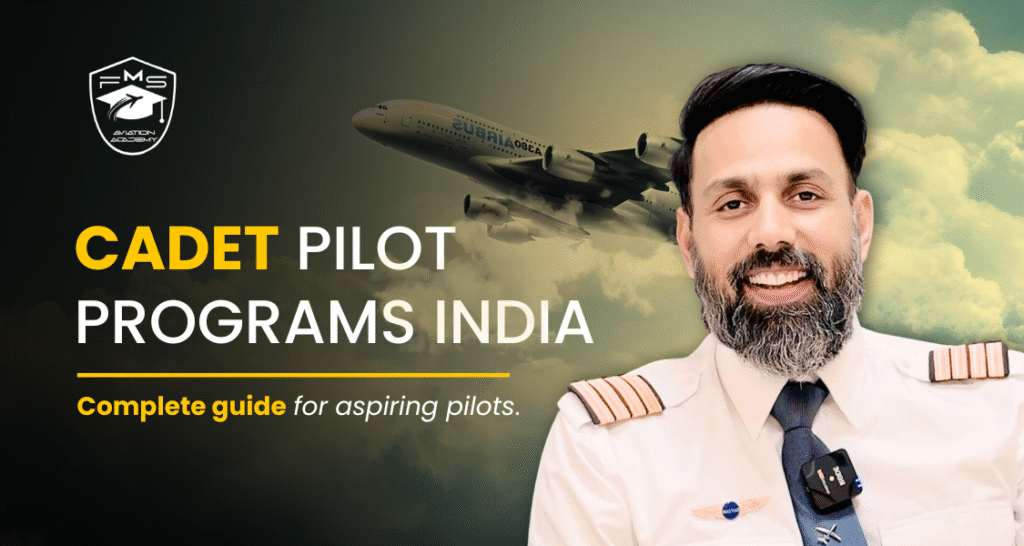
Cadet Pilot Programs in India: Complete Guide 2025

Dreaming of flying for India’s top airlines but unsure where to start?

Cadet Pilot Programs in India offer a structured, assured path from classroom to cockpit. But which program suits you? How do you prepare for selections? What’s the real cost? How long does training take?

This complete guide answers everything:

Eligibility requirements, selection processes, aptitude tests, interview tips, training timelines, and career outcomes.

By the end, you’ll know exactly which path to choose.

Ready to explore your path to the skies?

top Cadet pilot programs in India
Cadet Pilot Programs in India

What is a Cadet Pilot Program?

A cadet pilot program is an airline-sponsored training pathway for aspiring pilots. It is one of the methods of becoming a pilot in India. Also called “ab-initio training”, it is an alternative to conventional pilot training. 

You start with zero flying experience and the airline funds most of your training (through bank loans they facilitate). You receive structured training at pre-selected flight schools. Upon completion, you get a guaranteed First Officer position with that airline.

IndiGo launched India’s first cadet program in 2018, followed by SpiceJet and Air India. These programs have successfully produced hundreds of First Officers now flying across India.

The process is straightforward:

You apply → Clear selection tests → Sign Letter of Intent (LOI) → Complete training → Join as First Officer.

The airline manages your entire training journey.

Cadet Pilot Program vs Conventional Training

Cadet pilot programs eliminate uncertainties associated with conventional pilot training. Your choice depends on risk appetite and financial capacity.

Read our detailed comparison inCadet Pilot Program vs Conventional Training” to understand which path suits your aviation career goals.

Which Airlines Offer Cadet Pilot Programs in India?

Three major Indian airlines currently operate cadet pilot programs. Each program has unique features, costs, and training partners.

IndiGo Cadet Pilot Program

India’s largest airline launched the country’s first cadet program in 2018.

Key Features:

  • Training Partners: Marigold Aviation (USA), L3Harris (USA), Skyborne (UK), 43 Air School (South Africa), Insight Aviation
  • Training Locations: USA, United Kingdom, South Africa
  • Fleet Type Rating: Airbus A320 family
  • Program Duration: 24-30 months
  • Approximate Cost: ₹1.0-1.2 crores
  • Unique Advantage: Multiple training partner options to choose from
  • Current Status: Active with regular batch intakes throughout the year

Want detailed information on IndiGo’s program, selection process, and costs? Read our complete IndiGo Cadet Pilot Program Guide.

Air India Cadet Pilot Program (FlyHigh)

India’s flag carrier launched their cadet program in February 2024.

Key Features:

  • Training Partners: AeroGuard (USA), L3Harris (USA), Acron Aviation, own training academy
  • Training Locations: Air India Training Academy Amravati (Maharashtra) + USA facilities
  • Fleet Type Rating: Airbus A320/A350 or Boeing 737/787 (based on fleet requirements)
  • Program Duration: 24-30 months
  • Approximate Cost: ₹1.1-1.3 crores
  • Unique Advantage: Own state-of-the-art training academy in India, exposure to wide-body aircraft
  • Current Status: New program, actively recruiting for upcoming batches

Interested in Air India’s latest program details and application process? Read our comprehensive Air India FlyHigh Cadet Program Guide.

SpiceJet Cadet Pilot Program

SpiceJet’s program launched in 2018 with a unique scholarship component.

Key Features:

  • Training Partners: CAE, CTC Aviation, FTA, SpiceJet Aviation Training Academy Gurgaon
  • Training Locations: Gurgaon (India) + affiliated international schools
  • Fleet Type Rating: Boeing 737 or Bombardier Q400
  • Program Duration: 24-30 months
  • Approximate Cost: ₹85 lakhs-1.2 crores (before scholarships)
  • Unique Advantage: Merit-based scholarships up to ₹30 lakhs for top performers
  • Additional Option: BBA/MBA degree integration (+₹2 lakhs)

Want to know if you qualify for SpiceJet’s scholarship and program details? Read our complete SpiceJet Cadet Program & Scholarship Guide.

Comparing Cadet Pilot Programs: Which Suits You Best?

Each program has distinct advantages depending on your priorities.

Choosing between these programs requires detailed comparison of:

  • Total costs and payment structures
  • Training quality and locations
  • Fleet types and career progression
  • Selection difficulty and requirements
  • Post-training opportunities and salary growth

Need help deciding which airline cadet program aligns with your goals? Read our detailed comparison: IndiGo vs Air India vs SpiceJet Cadet Programs

International Cadet Pilot Programs

Qatar Airways Cadet Pilot Training Programme

Key Features:

  • Training Partner: Qatar Aeronautical College (QAC) – includes up to 18 months of science, maths & English prep + ~20 months of MPL-theory & practical training.
  • Eligibility Highlights: Qatari nationals (or children of Qatari mothers) aged 18–32, high school certificate (min 70 %), IELTS score required, Class 1 medical. 
  • Programme Duration: ~38 months (18 + 20 months) from foundation to pilot training. 
  • Unique Advantage: Full tuition support, monthly stipend during training, fixed job offer with Qatar Airways as Second Officer then First Officer.

Emirates Cadet Pilot Programme (via Emirates Flight Training Academy)

Key Features:

  • Training Partner: Emirates Flight Training Academy, Dubai – covers the full ATPL licence route, multi-crew co-operation, and commercial pilot licence with multi-instrument rating.
  • Training Fee: USD 181,650 (≈ ₹1.5–1.6 crore) including visa, accommodation, meals, uniforms and full training period.
  • Programme Duration: Approx. 104 weeks (around 2 years) for full course from zero hours to airline-readiness.
  • Unique Advantage: State-of-the-art campus with own airport/simulator facilities; international career pathway though for non-UAE nationals job guarantee may vary.

Read more about Emirates Cadet Pilot Programme here.

Domestic Cadet Pilot Programs Vs. International Cadet Pilot Programs

Aspiring pilots often wonder whether to pursue training in India or abroad.

Here’s a quick comparison of Domestic vs. International Cadet Pilot Programs to help you decide:

Domestic ProgramsInternational Programs
Conducted within India under DGCA guidelinesConducted abroad with global training standards (EASA/FAA)
Lower overall cost (₹1.2–1.5 crore)Higher cost (₹1.6–2 crore+)
Easier communication and familiar training environmentExposure to advanced simulators and global aviation practices
Airline placement limited to Indian carriersBroader career opportunities with international airlines

How Much Do Cadet Pilot Programs in India Cost?

Cadet programs are significant financial investments and understanding complete costs helps you plan better. Here’s a general overview of the investment required for cadet pilot programs in India across major airlines:

  • Total Investment: ₹85 lakhs to ₹1.3 crores depending on the program.
  • Bank Financing: Up to 95% financing available through partner institutions.
  • Down Payment: ₹10 lakhs to ₹20 lakhs.
  • Scholarships: Some programs provide merit-based scholarships.
  • Overall Cost Variation: Factors like training location, aircraft type, and scholarship eligibility influence the final expense.

What’s Included in Program Costs?

Complete Training Package:

  • DGCA ground training for all 6 subjects
  • DGCA Class 1 and Class 2 medical examinations
  • CPL flight training (200+ hours)
  • Multi-engine and instrument ratings
  • License conversion (if trained abroad)
  • Aircraft type rating (A320/B737/Q400)
  • Simulator training hours
  • Accommodation during training (most programs)
  • Study materials, uniforms, equipment
  • Airport transfers and logistics

What’s NOT Included?

Additional Expenses:

  • DGCA exam fees (₹2,500-5,000 per subject)
  • Visa and international travel costs
  • Personal expenses during training
  • Food and daily living costs (partially covered)
  • Travel insurance
  • Re-examination fees (if applicable)

How to Finance Your Training

Education Loans:

  • Major banks offer aviation-specific loans
  • Loan amount: Up to 90-95% of program cost
  • Interest rates: 9-12% per annum
  • Collateral requirements vary
  • Repayment starts after joining airline (usually 6 months into employment)

Loan Processing Tips:

  • Start application early (2-3 months before training)
  • Keep academic records organized
  • Co-applicant (parent/guardian) improves approval chances
  • Good credit score helps get better interest rates

Most airlines have dedicated loan facilitation teams to help candidates.

What are the Eligibility Requirements for Cadet Pilot Programs?

Meeting eligibility criteria is your first step.

Requirements are similar across all programs with minor variations.

Age Requirements

Minimum Age: 18 years at the time of application

Maximum Age: 32-35 years (varies by airline)

  • IndiGo: 32 years
  • Air India: 35 years
  • SpiceJet: 32 years

Start early to have multiple attempt opportunities.

Educational Qualifications

Mandatory:

  • 10+2 (12th standard) pass from recognized board
  • Physics and Mathematics as mandatory subjects
  • Minimum 50-60% aggregate (varies by airline)
  • English as a subject throughout schooling

Important Notes:

  • Science stream preferred but not mandatory
  • Commerce/Arts students can qualify through NIOS for Physics/Maths
  • International boards (IB, A-levels) accepted
  • Diploma holders eligible if meeting subject requirements

Nationality Requirements

You must be:

  • Indian citizen with valid Indian passport, OR
  • Overseas Citizen of India (OCI) cardholder
  • Unrestricted right to work in India

Medical Fitness Standards

DGCA Class 1 Medical Certificate Required:

Vision Requirements:

  • Distant vision: 6/6 in each eye (correctable)
  • Near vision: N5 at 30-50 cm
  • Color vision: Normal (Ishihara test)
  • Contact lenses/glasses allowed (within limits)

Physical Requirements:

  • BMI: 18-25 typically (airline grooming standards)
  • Height: Minimum 158 cm (SpiceJet); others flexible
  • No physical deformities affecting aircraft operation
  • Cardiovascular health within DGCA norms
  • Hearing standards: Conversational voice at 2 meters

Disqualifying Conditions:

  • Certain heart conditions
  • Epilepsy or seizure history
  • Severe mental health conditions
  • Substance abuse history
  • Some chronic diseases

Pro Tip: Get a preliminary medical check before applying to avoid disappointment later.

Some Cadet Pilot Programs admit DGCA Class 2 Medical qualified aspirants also, provided Class 1 Medical is cleared before training.

Language Proficiency

English Requirements:

  • Fluent in reading, writing, speaking
  • ICAO Language Proficiency Level 4 or higher
  • IELTS 5.5+ or equivalent (some programs)
  • Aviation communication requires clear English

Hindi proficiency helpful but not mandatory.

Additional Requirements

Documentation:

  • Valid passport
  • 10th and 12th marksheets
  • Birth certificate
  • Identity proof (Aadhar/PAN)
  • Recent photographs
  • Medical fitness certificate

Program-Specific Variations

SpiceJet Scholarship Eligibility:

  • 96%+ in PCM (Physics, Chemistry, Maths) for ₹30 lakh scholarship
  • 92-96% in PCM for ₹15 lakh scholarship
  • OR JEE Main rank 1-1500 for top scholarship

IndiGo:

  • Must be able to obtain US M1 visa for certain training partners
  • Background verification conducted

Air India:

  • Preference for candidates with cleared DGCA ground exams
  • Technical graduation (engineering) considered favorably

What is the Selection Process for Cadet Pilot Programs?

Cadet program selections are highly competitive with 5-10% success rates. Understanding each stage helps you prepare strategically.

The 7-Stage Selection Journey

Stage 1: Online Application (2-4 weeks)

  • Fill detailed form on airline/partner website
  • Upload documents: marksheets, photos, ID proof
  • Pay application fee: ₹5,000-10,000
  • Apply early when batches open for better chances

Stage 2: Aptitude Testing

Assessment Test and Complex Control Task (CCT):

  • Evaluates cognitive skills like multitasking, hand-eye coordination, and situational awareness.
  • Conducted on a simulator to test real-time decision-making and motor control.
  • Measures a candidate’s ability to manage multiple cockpit inputs under pressure.
  • Helps airlines identify candidates with strong aptitude for advanced flight training.
  • Read more about ADAPT and COMPASS Assessment Tests

Stage 3: Psychometric Assessment (45-60 minutes)

  • Evaluates: Personality, stress handling, decision-making, teamwork
  • Format: Computer questionnaire, scenario-based questions
  • Key: Answer honestly, airlines look for safety-conscious, calm personalities

Stage 4: Group Discussion (Some Programs)

  • Format: 6-10 candidates discuss aviation/current affairs topic
  • Duration: 20-30 minutes
  • Assessed: Communication, leadership, teamwork, logical reasoning
  • Tip: Listen actively, support with facts, don’t dominate

Stage 5: Personal Interview (15-30 minutes)

Common Questions for Cadet Pilot Program Interview:

  • “Why pilot?” “Why this airline?” “Tell us about yourself”
  • “How do you handle stress?” “Career goals?”
  • Basic technical: “How does an aircraft fly?” “What is DGCA?”

Interview Success Tips:

  • Research airline thoroughly, dress professionally
  • Show genuine passion, maintain eye contact
  • Answer concisely, prepare 2-3 questions to ask them

Stage 6: DGCA Class 1 Medical

  • Duration: 4-6 hours at DGCA-approved centers
  • Tests: Vision, hearing, ECG, blood tests, X-ray, psychological
  • Cost: ₹15,000-25,000
  • Critical: Medical failure can terminate candidacy

Stage 7: Letter of Intent (LOI)

  • Final confirmation of selection
  • Includes: Training schedule, fee structure, 5-year bond terms
  • Next steps: Sign LOI, pay deposit, begin loan process

Overall Timeline: 2-4 months from application to LOI (may vary by airline)

Cadet Pilot Program vs Conventional Pilot Training: Which Path Should You Choose?

This is the biggest decision aspiring pilots face. Both paths lead to the same destination – a commercial pilot license. But the journey differs significantly.

Quick Overview

Cadet Pilot ProgramConventional Pilot Training
Higher cost (₹85 lakhs – ₹1.3 crores)Lower cost (₹60 – 80 lakhs)
Guaranteed job with specific airlineNo job guarantee
Structured training managed by airlineSelf-managed training journey
5-year service bondFreedom to choose flight schools
Type rating includedNo service bond, can join any airline
Limited flexibility in training choicesMust find employment independently

The Smart Strategy

Many successful pilots take a hybrid approach:

Step 1: Clear DGCA ground exams first (at FMS Aviation Academy)

Step 2: Apply to multiple cadet programs simultaneously

Step 3: Simultaneously explore conventional flight school options

Step 4: Make final decision based on:

  • Which cadet programs you get selected for
  • Loan approval status
  • Financial situation
  • Personal preferences

This keeps all options open while maximizing success chances.

Want a detailed comparison with cost analysis, timelines, and case studies? Read our comprehensive guide: Cadet Pilot Program vs Conventional Training.

How to Prepare for Cadet Pilot Program Selection?

Preparation significantly improves your selection chances.

Here’s your step-by-step strategy:

1. Ensure Basic Eligibility

Before Anything Else:

  • Complete 10+2 with Physics, Mathematics (50%+ marks)
  • Get DGCA Class 2 Medical done (₹10,000-15,000)
  • Ensure you meet age requirements
  • Check vision is correctable to 6/6
  • Verify no major medical disqualifiers

Timeline: Start 6-12 months before application.

2. Clear DGCA Ground Exams (Highly Recommended)

Why This Matters:

  • Airlines prefer candidates with cleared exams
  • Shows serious commitment to aviation
  • Reduces training time in program
  • Strengthens your profile against other applicants
  • Gives you deeper aviation knowledge for interviews

The Six DGCA Subjects:

  • Air Navigation
  • Aviation Meteorology
  • Air Regulations
  • Technical General
  • Technical Specific
  • RTR(A) – Radio Telephony

Preparation Timeline: 4-6 months with FMS Aviation Academy. 

Read about our courses at DGCA Ground Classes.

3. Aptitude Test Preparation

Airlines use computer-based tests to assess pilot aptitude.

Generic Preparation Strategy:

  • Mental Math: Practice 30 minutes daily
  • Memory Skills: Training with memory apps and classic exercises
  • Spatial Reasoning: Using brain-training platforms and hands-on exercises
  • Coordination: Gaming with joystick, flight simulator practice (X-Plane, MSFS)
  • Multitasking: Dual-task training apps and divided attention exercises

Preparation Timeline: Start 2-4 months before application

Most Common Tests:
COMPASS Test: Used by IndiGo and other international airlines, tests mental arithmetic, memory, spatial awareness, and multitasking ability. ADAPT (Air India): Similar assessment measuring cognitive abilities, reaction time, and coordination skills specific to aviation tasks.

Read our comprehensive guide: How to Prepare for COMPASS and Aviation Aptitude Tests.

4. Interview Preparation

Research Phase:

  • Study airline’s fleet, routes, history
  • Understand company values and culture
  • Follow recent aviation news
  • Know basic aerodynamics (how planes fly)

Practice Phase:

  • Prepare answers to common questions (“Why pilot?” “Why this airline?”)
  • Mock interviews with mentors or family
  • Work on clear communication and body language
  • Record and review your practice sessions

Key Tips:

  • Dress professionally, maintain eye contact
  • Show genuine passion for aviation
  • Avoid filler words (“um,” “like”)
  • Prepare 2-3 questions to ask interviewer

5. Physical Fitness & Medical Prep

Lifestyle Management:

  • Maintain healthy BMI (18-25)
  • Regular exercise and 7-8 hours sleep
  • Eye care: breaks from screens, good lighting
  • No substance abuse whatsoever

Medical Planning:

  • Get preliminary checkup 6 months before
  • Address correctable issues early
  • Valid DGCA Class 1 medical certificate

6. Financial & Application Strategy

Financial Prep (3-6 months before):

  • Research education loans from multiple banks
  • Prepare documents: income proof, academic records, ID proofs
  • Discuss family investment capacity
  • Keep ₹10-15 lakhs ready for down payment

Smart Application Strategy:

  • Apply to multiple programs (IndiGo, Air India, SpiceJet)
  • Track all deadlines in calendar
  • Apply early when batches open
  • Keep documents organized digitally
  • Follow up on application status

Application fees (₹5,000-10,000 per program) are minimal compared to training costs.

What is the Training Timeline in Cadet Pilot Programs?

Complete training takes 21-30 months from enrollment to First Officer appointment.

Timeline varies by airline and training partner.

Complete Journey Breakdown

Phase 1: Ground School (2-4 months)

  • Location: India (airline academy or partner institute)
  • Training: DGCA theory exams (6 subjects) – Air Navigation, Meteorology, Regulations, Technical General/Specific, RTR(A)
  • Hours: 470+ hours structured instruction

Phase 2: Flight Training (12-15 months)

  • Location: USA (Florida), South Africa, Australia, or India
  • Training Includes:
    • Private Pilot License: 40-50 hours
    • Commercial Pilot License: 150+ hours
    • Instrument Rating: Advanced navigation
    • Multi-Engine Rating: Twin-engine operations
  • Total Flying: 200-250 hours
  • License: FAA CPL or SACAA CPL or DGCA CPL
  • Accommodation: Included in most programs

Phase 3: License Conversion (1-2 months)

  • Location: India
  • Required for: Foreign licenses only (FAA/SACAA to DGCA)
  • Process: Flight tests, documentation, validation
  • Skip if: Trained at DGCA-approved Indian FTO

Phase 4: Type Rating (5-6 months)

  • Aircraft: A320, B737, or Q400 specific training
  • Ground School: 3-4 weeks (systems, procedures, emergencies)
  • Simulator: 40-60 hours (normal ops, emergency scenarios)
  • Base Training: 2-3 weeks (actual aircraft on ground)
  • Line Training: 4-6 weeks (real passenger flights with training captain)
  • Final Check: Line check with examiner
  • Outcome: Type-rated First Officer ready for operations

Phase 5: First Officer Operations (Month 24-30)

  • Initial supervised flying
  • Building experience and confidence
  • Full independent operations begin
  • Congratulations – you’re an airline pilot!

Program-Specific Timelines

  • IndiGo (via different partners):
  • Marigold Aviation: 21 months
  • L3Harris: 19 months + 2 months type rating
  • Skyborne: 16-20 months
  • Insight Aviation: 21 months total
    1. Air India FlyHigh: 24-28 months
    2. SpiceJet: 24-30 months
    3. Emirates: 21-24 months
  • Qatar Airways: 18-24 months

Factors Affecting Duration:

  • Weather at training location
  • Aircraft availability
  • Individual progress pace

What Happens After Completing a Cadet Pilot Program?

Upon completion, you join as First Officer with guaranteed employment and structured career progression.

Your Career Journey:

  • First Officer Appointment: Join airline with ₹6-12 lakhs initial package plus flying allowances
  • 5-Year Service Bond: Commitment to airline protects their training investment
  • Year 1-2 (Junior F/O): Domestic routes, 70-90 hours monthly, ₹10-15 lakhs per annum
  • Year 3-5 (Senior F/O): International routes, training duties, ₹18-25 lakhs per annum
  • Year 5-10 (Captain Track): Command training eligible, ₹5-8 lakhs monthly salary

Career Benefits: Free/discounted travel, medical insurance, international layovers, airline perks.

Check out Pilot Salary in India for a complete breakdown.

Conclusion

Contact FMS Aviation Academy for expert guidance on Ground Classes with a Senior Airline Captain. Backed by 17+ years of aviation experience, get valuable insights on aviation and pilot training. Visit our centres at Surat, Ahmedabad, Delhi and upcoming Dehradun!

Reach out today and begin your journey toward a successful airline career!

FAQs on Best Pilot Training Institute in Delhi

Related Posts

A320 Type Rating Course India
Pilot Training

A320 Type Rating Course India: Fees, Duration & DGCA Approval Guide

Home A320 Type Rating Course India: Fees, Duration & DGCA Approval Guide The A320 Type Rating Course India is essential for Airbus airline careers. Airlines hiring A320 First Officers prefer DGCA-compliant type rating holders. Therefore, understanding A320 type rating fees, duration, and DGCA rules is vital. This guide explains A320
Read More »
Hidden Costs of Pilot Training
Pilot Training

Hidden Costs of Pilot Training: What Your Academy Might Not Tell You

Home Hidden Costs of Pilot Training: What Your Academy Might Not Tell You Pilot training cost is often advertised attractively by many flight schools. However, hidden costs of pilot training can increase your total expense sharply. Understanding real commercial pilot training cost helps avoid financial stress. Before enrolling in CPL

Read More »
Why Is Delhi-NCR Hub for DGCA Ground Classes 2026
Pilot Training

Why Is Delhi-NCR Hub for DGCA Ground Classes 2026

Home Why Delhi-NCR is the Hub for DGCA Ground Classes in 2026 Delhi-NCR has become the preferred destination for DGCA ground classes in India. Pilot aspirants increasingly choose NCR for structured DGCA exam preparation. The region offers strong faculty access, aviation ecosystem exposure, and career guidance. In 2026, Delhi-NCR clearly

Read More »
2026 Pilot Hiring India: Which Indian Airlines are Recruiting Freshers?
Pilot Training

2026 Pilot Hiring India: Which Indian Airlines are Recruiting Freshers?

Home 2026 Pilot Hiring India: Which Indian Airlines are Recruiting Freshers? 2026 Pilot hiring India is entering a strong growth phase ahead of airline expansion. Indian airlines are inducting new aircraft, creating demand for fresher commercial pilots. Fleet growth, route expansion, and retirements are driving airline pilot recruitment in India.

Read More »
How to Become a Pilot for Commerce & Arts Students in India
Pilot Training

How to Become a Pilot for Commerce & Arts Students in India

Home How to Become a Pilot for Commerce & Arts Students in India (2026 Guide) How to become a pilot for commerce & arts students is a common query. Many students believe only science students can become pilots in India. However, commerce and arts students can also pursue pilot training

Read More »
Electronic Personnel Licence India
Pilot Training

Electronic Personnel Licence India Explained: DGCA’s Latest Launch

Home Electronic Personnel Licence India Explained: DGCA’s Latest Launch Introduction to Electronic Personnel Licence India The Electronic Personnel Licence India is a major digital reform in Indian civil aviation. It is a secure digital licence issued by DGCA. It aligns India with ICAO-compliant global aviation digitisation standards. What Is an

Read More »
Private Pilot License
Pilot Training

Private Pilot License: Course, Duration, Cost in India

Home Private Pilot License in India: Course, Duration, Cost, and Career Insights A Private Pilot License in India is the first formal step into aviation flying. It allows pilots to fly aircraft for personal and non-commercial purposes. Many aspiring airline pilots begin with a PPL to build strong flying fundamentals.

Read More »
Female Pilot Training Guide India
Pilot Training

Female Pilot Training Guide India: Eligibility, Cost, Career & Preparation

Home Female Pilot Training Guide India: Eligibility, Cost, Career & Preparation Female pilot training guide India is explains pilot training for women in India. Career opportunities are rising rapidly with airline diversity initiatives. More women are choosing aviation as a stable and rewarding career. Given rising Demand for Pilots in

Read More »